Transplant Rhubarb: How to Split Rhubarb Crowns

Learn how to divide and transplant rhubarb in your garden, so you can grow your own rhubarb for baking, juicing or preserving.

Rhubarb is a hardy perennial vegetable in USDA growing zones 3-9. It's an old fashioned plant and for most gardeners, it's one of the first spring crops they can harvest.
This perennial lives a long, long time after the roots are established (20+ years). If you learn how to harvest rhubarb without damaging the crowns, just a few plants will give you all the rhubarb you could possibly want!
In my kitchen, we freeze rhubarb raw, make rhubarb freezer jam with honey or a sweet rhubarb juice concentrate that is delicious over a glass of ice!
Rhubarb earns its keep by being hardy, low maintenance, easy to plant and easy to care for.
In my gardens, I like to split rhubarb crowns and transplant them, instead of buying young crowns from a local garden center.
Here's why!
Planting Young Crowns vs Splitting and Transplanting Rhubarb
If you buy young crowns from a local garden center, you have to wait 2-3 years before you get a full harvest. The baby plants need to mature and establish their root system.
But if you learn how to split rhubarb crowns from an established plant in early spring? You can transplant rhubarb crowns and still get a harvest the same year!

Benefits of Splitting Rhubarb Plants
Here are the 4 key reasons to divide established plants and transplant rhubarb crowns into your garden.
Rhubarb starts taken from your garden, a friend or neighbor will be acclimatized to your growing zone, and plants will be healthier.
- Splitting rhubarb crowns saves money.
- Divisions from an older plant are usually vigorous and healthy, while young crowns can be lethargic in their growth.
- Rhubarb transplanted in the spring will produce a harvest that very spring.
Best Time to Split Rhubarb for Transplanting
You can divide rhubarb in the spring or the fall.
Personally, I like to split rhubarb in the spring. I prefer this option, because I can see whether or not the crowns took. I get to harvest from the splits that very summer, and if I see the growth, I won't forget where I put the transplants!
But you can divide rhubarb in the fall as well, after the leaves and stalks have died back.
How to Split Rhubarb in the Spring
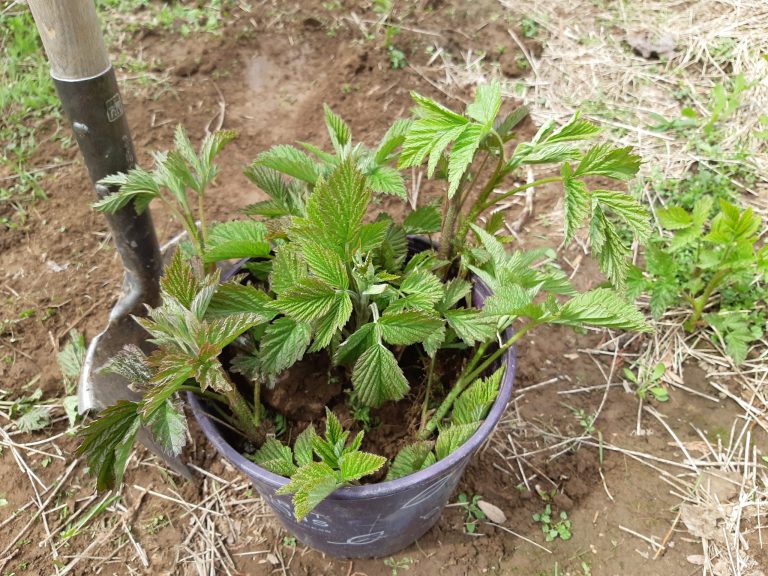
If you split rhubarb crowns in the spring (as shown in this tutorial), you want to dig a small portion of root early on, while the rhubarb stalks and leaflets are less than 8 inches tall.
If you properly transplant rhubarb in your garden, the roots will take hold immediately.
How to Divide Rhubarb in the Fall
If you divide rhubarb crowns in the fall, you should wait until the foliage has died back. With fall division, you may want to mark the base of your rhubarb plant, so you know exactly where the roots are located.
Transplant rhubarb as soon as the leaves die back, so the roots have time to establish themselves before winter sets in.
Because I've only divided and transplanted rhubarb in the spring, the rest of this tutorial is going to center on a spring transplant!
How to Split Rhubarb Crowns in Spring
Rhubarb is hardy, so don't worry about killing the parent plant when you take your first division! Just follow the directions I share below. The parent (likely the transplant too) will produce a full summer crop.
How to Assess Your Rhubarb Plant
- Before you divide, make sure rhubarb leaves are no more than 8-10 inches tall.
- Pull leaves back and find the circumference of the crowns in the earth.
- Use a shovel to mark off 1/4-1/3 of the crowns.

How to Take a Root Division
- Use your shovel to cut through the line you created, and divide roots from the parent plant.
- Jump up and down on your shovel, until the spade is buried in the earth.
- Dig a wide circle around the crowns you want to transplant (stay 8 inches away from the base, so you take as much root as possible).
- Lift your root wad and backfill the hole, so the parent plant is protected.
- Transplant your root division immediately.

How to Transplant Rhubarb Splits
- Slip your rhubarb split into a 5 gallon bucket if you have to transport it.
- Choose your location for transplanting.
- Dig a deep, deep hole and loosen soil in the bottom.
- Gently transfer your rhubarb split to the hole.
- Backfill with loose soil, until the stalks are buried 1-2 inches deeper than before.
- Water immediately, then leave the roots to take hold.

Caring for Your Rhubarb Transplant
Rhubarb Water Requirements
If you live a hot climate or have fast draining soil, you may want to water rhubarb transplants every 7 days for the first few weeks. After that, play it by ear. You know your climate (and I don't), so go with your gut instinct after that!
Use a Mulch Cover
Gardeners living in a wet climate don't need to mulch their rhubarb (it offers protection to slugs). But if you have a hot climate, you can use 1-2 inches of leaves, straw or wood chips to help retain moisture.
When to Harvest Rhubarb
You can probably harvest the same spring you transplant rhubarb. Take stalks when they are 10-14 inches in length.
Make sure 8-10 green stalks are always present on the plant. The following spring you should be able to harvest freely without setting the crowns back.
Regardless of age, you should stop harvesting by mid summer, and let the plant rest through the heat of the summer.

How to Harvest Rhubarb
This is a particular way you should harvest rhubarb to avoid damaging the crown. I teach you how to harvest rhubarb here.
Always throw out the big, green fan-shape leaves! They are poisonous to human and animals alike. You can compost them, or use them as mulch around the base of your rhubarb plant.
The Best Ways to Use Rhubarb in the Kitchen
Rhubarb isn't a staple in the kitchen. It's a filler with lots of flavor (kind of like dill pickles).
It's extremely sour, and needs lots of honey or sugar to make it palatable. But rhubarb pairs well with fruits that lose flavor when cooked or baked.
Apples, blueberries, Saskatooons (June berries), strawberries and sweet cherries pop with flavor when you add a handful of rhubarb to the recipe!
If you like this idea, you should learn how to freeze rhubarb, so you have it on hand at all times.
Here are two of my other favorite rhubarb recipes.
Rhubarb Freezer Jam with Honey
Rhubarb Juice Concentrate (naturally sweetened)

Very, very helpful from someone who is afraid to divide my beautiful rhubarb plant! Now I will.
This was the exact information i was looking for! Currently I harvest my rhubarb from my aunt's patch (which was planted by her mother probably 75 years ago!) and it desperately needs to be divided as it has many small divisions with the stalks growing up through each other making it difficult to harvest. A friend's husband had dug up a full-grown plant for me about 10 years ago that voles ate the roots and killed it. Remembering the size of the root (and my amazement!), I was dreading the thought of trying to dig up divisions from this patch. Seeing your picture of the "root wad" gave me encouragement that the job is not as daunting as I feared. Thanks for that picture too!
I didn't know voles would eat rhubarb roots...how frustrating! Glad you found inspiration to try again. 🙂
Hi Autumn,
We live in Southern Ontario and I want to split my daughter rhubarb for myself to transplant in my yard. Does it require a lot of sun and when is the best time for me to split it?
Like I mentioned in the article, spring is the best time to split, when the very first leaflets appear. 🙂 Rhubarb can do partial shade or full sun.
How would I go about transplanting the entire plant?
Rhubarb has a massive root system, so you'd have to do a lot of digging to lift the entire thing! You may just want to take a division and give the rest away to someone else?
I would like to divide my plant this fall. When is the best time and do I pullI up the entire plant.? I live in zone 5 -Colorado
No, dont pull the whole plant! Just dig a 1/4-1/3 of it up. And for a fall transplant, I would do it as soon as possible.
Thanks for telling me how to start some rhubarb from another plant can’t wait for it to come up
Hope it takes well for you!
Fantastic, thank you! I was worried about damaging my plants as I get so much from them but you have put my mind at ease!!
In my experience, it's a simple and easy thing to do! 🙂
Thank you very much for your thoughtful and detailed article on dividing rhubarb. So uncluttered with more ads than article - a rare and beautiful thing. Although I do not want more email I applaud your generosity in sharing and shall share the resource. I wish you peace and happiness, Rod Mitchell.
Glad you found this tutorial helpful! I'm losing money by not running ads, but I choose not to because I want to create a simple, undistracted place where ppl can come, read and learn. 🙂 All the best,
Autumn